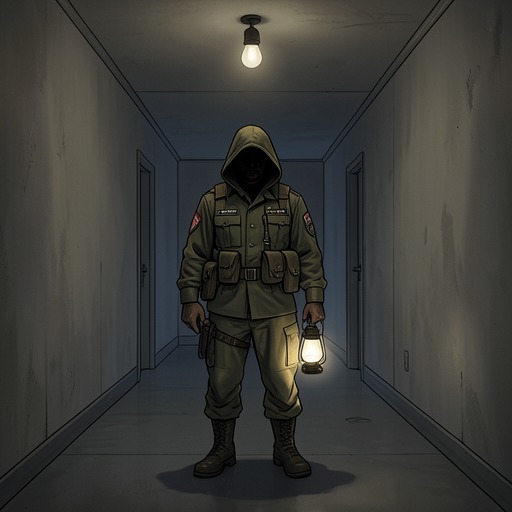
Psychosis (dementia praecox · schizophrenia)
The Surgeon of CrowthornePsychosis (dementia praecox / schizophrenia) is the changing diagnostic framework through which the book considers William Chester Minor’s long illness, not a single timeless label that can be applied without qualification. The account moves from an army surgeon’s 1868 description of monomania to a 1918 diagnosis of dementia praecox, paranoid form, and then to later discussion of schizophrenia, its possible causes, and changing treatments. That history remains unsettled: it offers no definitive explanation for Minor’s illness, while showing how medical language and institutional care shaped the life available to him.
From monomania to a named condition
In the summer of 1868, after reportedly remaining too long in the Florida sun, Minor complained of severe headaches and vertigo. He was escorted to New York to be examined by doctors connected with his former unit. By September, his condition was regarded as serious enough for suspicion to become a formal medical concern. On 3 September, Surgeon Hammond described him as suffering from monomania, a term then used for an intense fixation on a single subject. Hammond did not identify the subject, but considered Minor delusional. Minor was thirty-four.
The army’s records soon recommended that Minor was unfit for duty or travel and should be institutionalized. By November, a doctor characterized his condition as both suicidal and homicidal and recommended the care of the superintendent of the Government Hospital for the Insane in Washington. These were judgments made within the medical vocabulary and practices of the period; the account does not treat monomania as an exact equivalent of a later diagnosis.
Decades afterward, at St Elizabeths Hospital, Minor received a more specific classification. On 8 November 1918, his attending psychiatrist, Dr Davidian, recorded dementia praecox, paranoid form. The shift matters: the earlier, broad label of monomania gave way to a diagnosis situated within a developing psychiatric system. The book presents this as an important historical change in how Minor’s condition was described, rather than proof that the terminology of 1918 supplies a final or universally valid account of his illness.
What dementia praecox meant
The term dementia praecox had been in use for about twenty years when Dr Davidian applied it to Minor. Its literal sense pointed to an early decline in mental powers, distinguishing the condition from senile dementia, which was associated with deterioration in old age. In the account’s description, the relevant pattern was a loss of touch with reality beginning earlier in life, rather than a condition arising specifically from ageing.
Emil Kraepelin published the nomenclature in Heidelberg in 1899 as part of a wider effort to classify mental illnesses. His system distinguished dementia praecox from manic-depressive psychosis, which could resemble it but was treated as a different illness. Kraepelin regarded dementia praecox as endogenous: a disorder without an identifiable external cause. The book explains that this distinction reflected the limits and assumptions of the classification system of the time, not a settled explanation for what had happened to Minor.
Kraepelin divided dementia praecox into three subtypes. Catatonic cases involved markedly increased or diminished bodily movement; hebephrenic cases were associated with deeply inappropriate behaviour emerging around puberty; and the paranoid form involved delusions, often of persecution. Minor’s 1918 classification placed him in this last group. His earlier fears and illness are thereby connected to a contemporary diagnostic category, although a label cannot by itself establish why those experiences began or how they developed.
Changing terminology, treatment, and causation
The name schizophrenia appeared in 1912 and later became more familiar than dementia praecox. The book describes this as a change in psychiatric nomenclature, while noting that the name itself could also change. It contrasts these evolving terms with the Victorians’ use of broad categories and with the period’s moral treatment, an approach associated in the account with the influence of Philippe Pinel. The terminology does not stand apart from history: each label belongs to a particular attempt to classify distress and decide how patients should be cared for.
The treatments available to Minor’s generation were limited. The account describes people classified with paranoid dementia as generally considered incurable and removed from society by court order, often kept in institutions behind high walls. Minor spent most of his final forty-eight years in state asylums after killing George Merrett; for forty-seven of those years he was confined, and the care available to him was, in the book’s account, essentially without effective treatment. Sedatives such as chloral hydrate, sodium amytal, and paraldehyde were introduced around the time of his final decline. Later antipsychotic drugs offered ways to manage some symptoms, but the book stresses that treatment advances had not supplied a definitive account of the illness’s triggers.
The causes remain unresolved in the narrative. It asks whether the Battle of the Wilderness might have contributed to Minor’s later behaviour, and whether his wartime experience, his branding of an Irishman, or subsequent imprisonment had any role in the course of his illness. These remain questions, not established causes. The book also raises possible genetic predisposition and temperament, while noting that two of Minor’s relations had died by suicide and that the circumstances were uncertain. Its account resists reducing the illness either to a single traumatic event or to a simple explanation of personality. Modern psychiatrists, it says, commonly allow for the cumulative effect of multiple factors rather than claiming certainty about a specific trigger.
Minor’s life and the limits of diagnosis
Minor’s case makes the distinction between diagnosis and explanation especially visible. The record establishes a sequence of changing medical judgments: concern during his army service, the 1868 description of monomania, and Dr Davidian’s 1918 classification. It also establishes a long confinement following the killing of George Merrett. But this sequence does not disclose a definitive cause. The book considers genetic vulnerability, temperament, battlefield experience, and institutional conditions as possibilities, while explicitly leaving their relative importance uncertain.
The account also connects Minor’s life to the changing prospects of psychiatric care. It observes that people living with schizophrenia today may, with compassionate care and medication, build dignified lives in circumstances largely denied to Minor. At the same time, it cautions against a neat counterfactual: treatment that might have reduced some of his symptoms could also have changed his capacity or inclination to undertake the Dictionary work that became central to his days. This is not offered as a reason to romanticize illness or inadequate care, but as an irony in the particular shape of Minor’s history.
His work on the Oxford English Dictionary gave him a steady intellectual focus. The account describes the routine of preparing dictionary slips, month after month and year after year, as providing at least some release from paranoia. The work did not resolve his illness or remove the conditions of confinement, but it served as a fixed point around which he could organize sustained effort. When the Dictionary ceased to provide that stimulus, his condition and his life began to deteriorate. The contrast is stark: the diagnostic record names and classifies his distress, while the work records a practice that appears to have offered limited relief. Neither makes the illness fully legible, and the book leaves its causes open even as it shows how deeply diagnosis, confinement, and intellectual routine shaped Minor’s life.